While Western automakers spent the 1960s developing more luxurious and comfortable vehicles, the Soviet Union faced a very different challenge. Instead of focusing on style and aerodynamics, Soviet engineers were tasked with creating a machine capable of crossing frozen rivers, deep snow, swamps, and the unforgiving wilderness of Siberia. The result was the ZIL 167, one of the most ambitious off-road prototypes ever built in the Soviet Union.
Why Was the ZIL 167 Developed?
After World War II, the Soviet Union turned its attention to the vast natural resources hidden beneath Siberia. The region contained enormous deposits of gold, diamonds, magnesium, zinc, and other valuable minerals, but reaching them was far from easy. Temperatures below -40°C (-40°F), endless tundra without roads, and frozen rivers made conventional vehicles virtually useless.
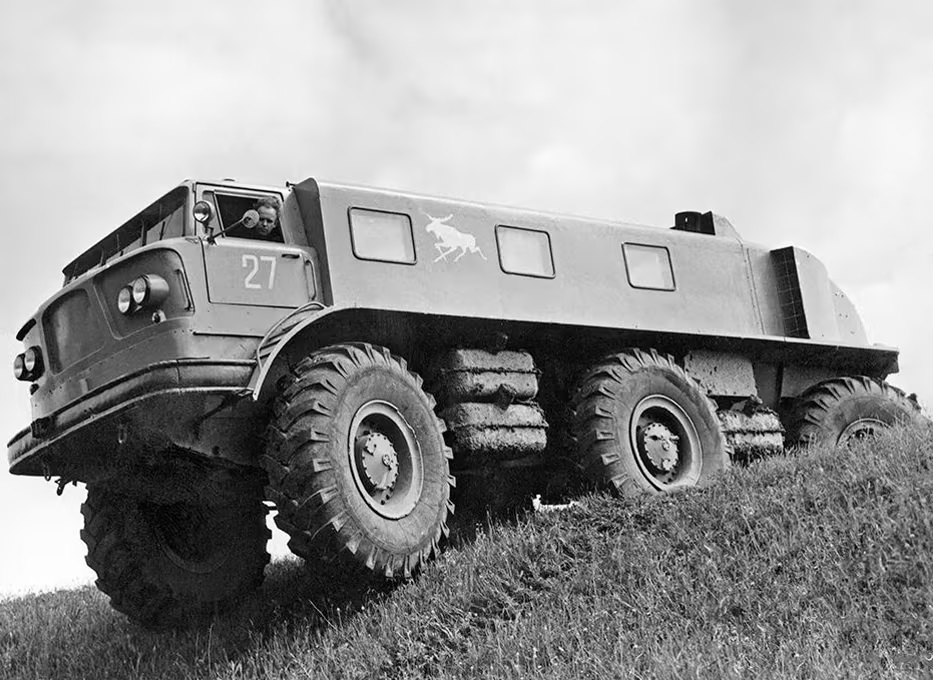
To solve this problem, the government commissioned the development of a new all-terrain vehicle capable of transporting both people and equipment through some of the harshest environments on Earth.
ZIL Takes on the Challenge
The task was assigned to ZIL (Likhachov Automobile Plant), a manufacturer already well known for producing heavy trucks, military vehicles, and luxury limousines for Soviet leaders. Engineers used the ZIL 135 military truck—with its eight wheels and twin-engine layout—as the starting point for an entirely new design.
In November 1961, the Soviet government set an ambitious deadline: the prototype had to be completed by January 1963. A team of around fifteen engineers worked almost around the clock to meet the demanding specifications. The vehicle had to carry at least three tons of cargo, feature six-wheel drive, offer exceptional ground clearance, and perform reliably in the most extreme terrain imaginable.
Impressive Engineering
The finished ZIL 167 measured 9.26 meters (30.4 feet) long, 3.13 meters (10.3 feet) wide, and stood more than three meters (9.8 feet) tall, with a curb weight of nearly seven tons.
Its most striking feature was its enormous wheels, each measuring 1,790 millimeters (70.5 inches) in diameter—larger than the average adult. Every wheel had its own drive system, while the fully independent suspension allowed the vehicle to adjust its ride height depending on the terrain. As a result, the ZIL 167 could travel through snow up to one meter deep and ford water nearly 1.8 meters deep.
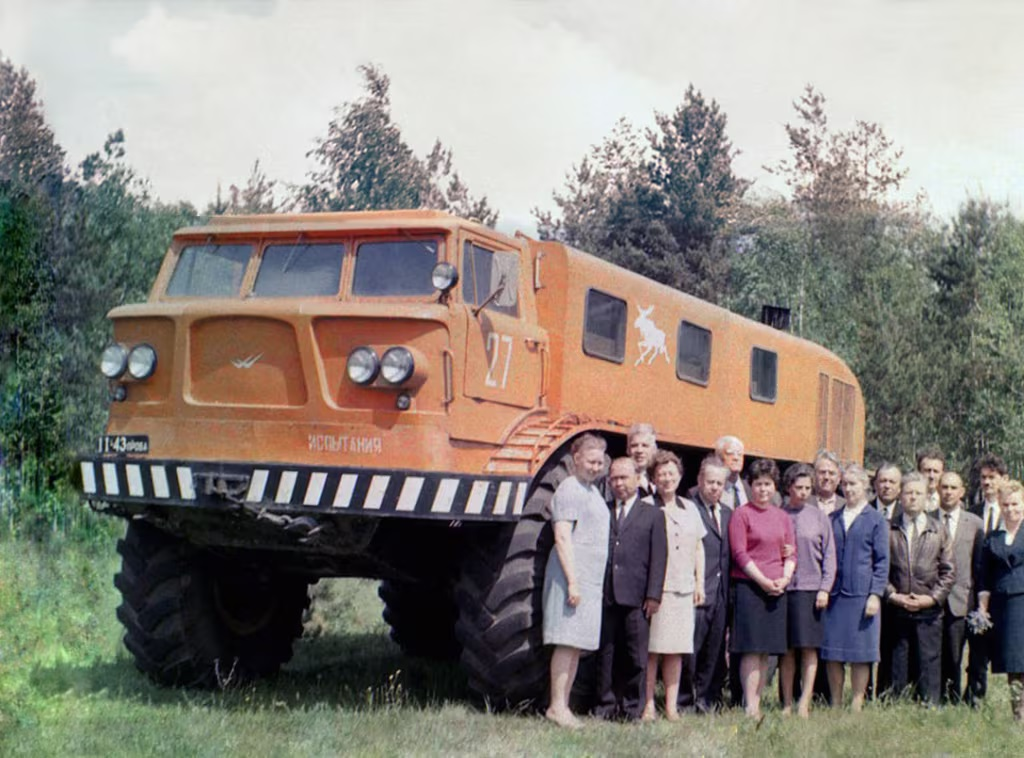
Power came from two 7.0-liter V8 gasoline engines producing a combined 360 horsepower. Although its top speed was only around 65 km/h (40 mph), speed was never the priority. The vehicle was designed to keep moving where almost anything else would get stuck.
Fuel economy certainly wasn’t a concern. Consumption exceeded 100 liters per 100 kilometers, but for a government-funded project, efficiency ranked far below capability. A massive 900-liter fuel tank provided impressive operating range, while the cabin accommodated four occupants and the cargo area could carry up to five tons of equipment.
Testing Proved Its Capabilities
The first prototype was completed in early 1963 and immediately underwent testing around Moscow before being sent to the Perm region for more demanding trials. Engineers deliberately drove it through deep snow, frozen rivers, and muddy swamps, even intentionally getting it stuck to evaluate its recovery abilities.
Thanks to its six-wheel-drive system and advanced suspension, the ZIL 167 repeatedly pulled itself free. During testing, it covered more than 1,500 kilometers without any major mechanical failures, impressing government officials. The results were so promising that two additional prototypes were ordered—one for search-and-rescue operations and another for geological expeditions.
Why It Never Reached Production
Despite its impressive performance, the final evaluation revealed one major weakness. The transmission could not reliably handle the combined output of the two V8 engines over extended periods.
Developing a stronger drivetrain would have required significant additional investment, while ZIL was already working on a new tracked vehicle that promised better performance at a lower cost. As a result, the ZIL 167 project was officially canceled in 1964.
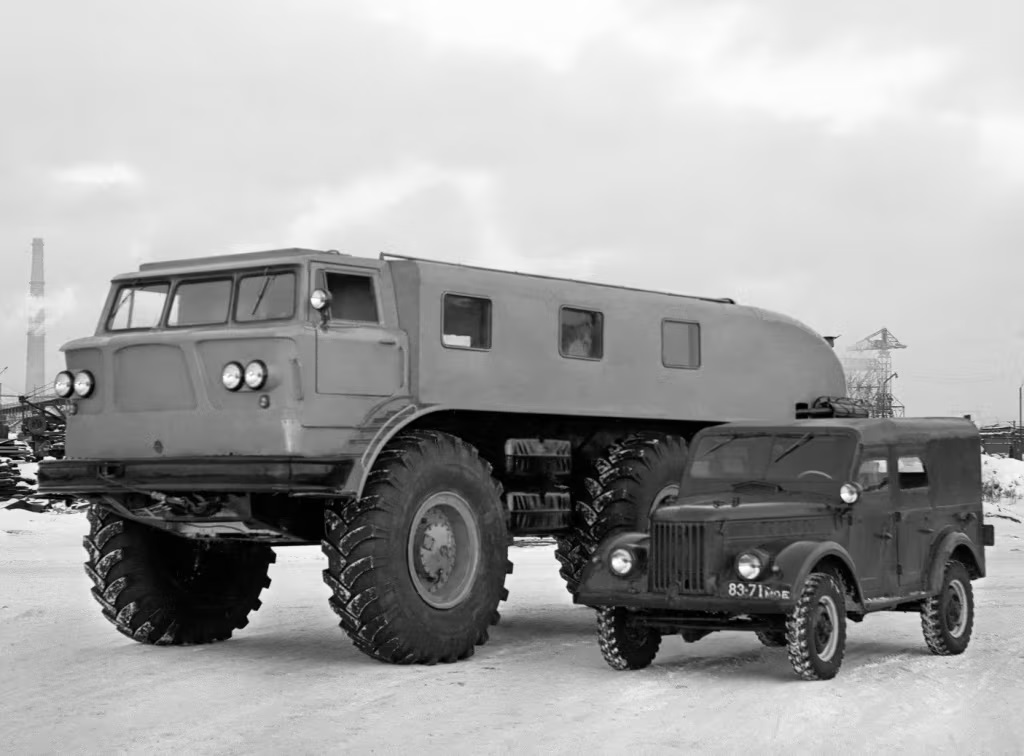
The prototype was left behind the factory, where it remained forgotten for decades. Today, it is still owned by the company and stored near Moscow, where it can only be viewed with special permission.
The Legacy of the ZIL 167
Although the ZIL 167 never entered mass production, its engineering solutions lived on. Many of its ideas were incorporated into the ZIL 49061, an amphibious rescue vehicle that entered serial production in 1975 and remained in service until 1991. It continued operating even after the collapse of the Soviet Union and was notably used during the devastating floods in Germany in 2002.
Today, the ZIL 167 stands as a symbol of an era when Soviet engineers pushed the limits of what was mechanically possible. It never became a commercial success, but it remains one of the most remarkable off-road prototypes ever created—a vehicle built not for luxury or prestige, but for survival in some of the harshest conditions on the planet.

